The Resident Engagement Playbook for Property Managers
What resident engagement actually means on site, how to tell whether it's working, and the seven levers that move it, with a 90-day plan you can start this month.
Ask ten property managers what resident engagement means and you'll get ten answers, most of them about events. Events are part of it. But engagement is broader and more practical than that: it's whether residents pay attention when you talk, take part when you ask, and feel like they live somewhere rather than just rent there.
You can see it on site. It's the resident who answers your poll, the couple who come down for the courtyard cookout, the person who tells the maintenance tech "thanks, Marcus" instead of just signing the work order. Those residents are more likely to renew, more patient when something breaks, and more likely to say good things about your community where other people can read them.
This playbook covers what engagement looks like in practice, how to tell whether yours is improving, and the seven levers that move it. At the end there's a 90-day plan you can start this month without a bigger budget or more staff.
What resident engagement actually is
Attention, participation, belonging
It helps to break engagement into three layers, because each one needs something different from you.
- Attention. Residents notice and read what you send. Without it, nothing else works: your event flyer, your pool closure notice and your renewal reminder all land on people who aren't looking.
- Participation. Residents do something when you ask: vote in a poll, RSVP, show up, submit a photo, nominate a neighbor.
- Belonging. Residents feel connected to the place and the people in it. This is the layer that shows up in renewals and reviews, and it's built out of many small moments of the first two.
Most engagement efforts jump straight to belonging with a big event and wonder why turnout is low. Turnout is low because nobody was paying attention to the invitation. Start at the bottom layer.
Why it's worth your time
Engagement isn't a nice-to-have bolted onto operations. It makes the operational parts easier. Residents who read your updates call less about things you already announced. Residents who feel heard are calmer when you have to deliver bad news. And residents who know their neighbors and like the place have one more reason to stay when their lease comes up, which matters more than almost anything else you control.
How to tell whether it's working
You don't need a dashboard to start, but you do need a few numbers you check the same way every month. Pick three or four of these and write them down monthly.
- Opens or views of your newsletter or main monthly message, as a share of households.
- Poll or survey responses per issue.
- Event turnout, roughly counted, compared with how many households you invited.
- Replies and two-way messages: residents answering a question, not just reporting a problem.
- Repeat participants: the same residents showing up or answering month after month is a good sign, not a bad one.
- Renewal conversations: how often residents mention community, staff or events as a reason they're staying.
The trend matters more than the number. A community where 15% of households answer the monthly poll and that number creeps up every quarter is in better shape than one that got 40% once for a giveaway and never again.
The seven levers
1. A communication rhythm residents can count on
Everything else rides on this. Residents engage with messages they expect and recognize. A newsletter that arrives on the same day every month, from the same sender, with the same basic shape, becomes something residents look for. Random blasts whenever there's news become something they skim and delete.
Pick a channel mix you can keep up (most communities do well with one monthly newsletter plus short texts for time-sensitive things), choose a day, and hold it. How often to send a resident newsletter goes deeper on cadence, and the complete guide to apartment newsletters covers what to put in it.
2. Small events, every month
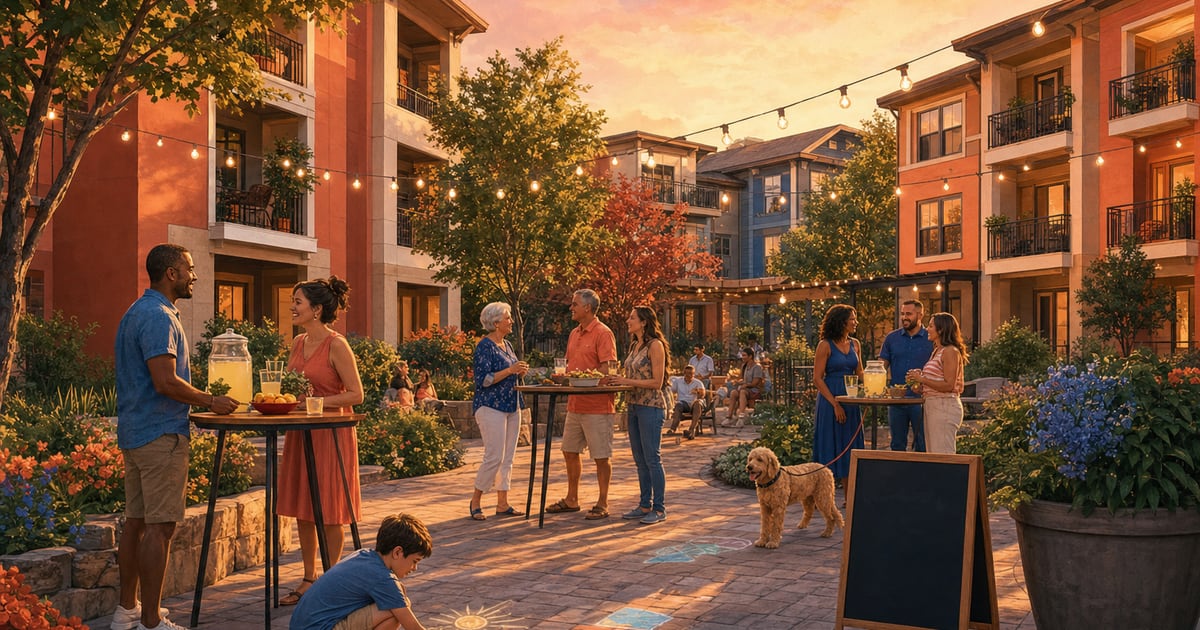
One big annual party does less for engagement than twelve small, reliable ones. A monthly coffee-and-donuts morning, a food truck on the third Thursday, a dog park meetup, a book swap shelf in the clubhouse. These cost little, take an hour of staff time, and give residents a regular, low-pressure way to meet each other.
Make them easy to say yes to: short, at a predictable time, with something to eat or do so nobody has to make small talk from a standing start. Announce them in your newsletter, remind by text the day before, and take a couple of photos for next month's issue so residents who missed it see what they missed.
3. Ask questions residents can answer in a tap
Residents like being asked, as long as answering is easy and something happens afterward. A one-question poll ("Food trucks or trivia night next month?") will get far more answers than a 20-question survey, and it gives you a reason to come back with results.
Ask about things you can actually act on: event choices, amenity hours, what they want more of in the newsletter, how a recent change is going. Save longer surveys for once or twice a year, and keep those to ten questions or fewer.
4. Close the loop, visibly
This is the step most communities skip, and it's the one that makes residents keep answering. When residents vote, tell them the result. When they ask for something, tell them what you did about it, even if the answer is "not yet, and here's why."
A short "You asked, we did" section in each newsletter works well: "You voted for trivia night, so it's on the 18th." "Several of you asked about the gym hours; they now start at 5 AM." Residents who see their input turn into something are the ones who answer the next poll.
5. Recognize people
People engage with people. Recognition gives residents a reason to read and a reason to feel part of the place.
- Employee of the month. A photo, a name, a line from a resident about why. It humanizes your team and makes residents more patient with them.
- Resident of the month or neighbor shout-outs. Let residents nominate each other for small kindnesses: carrying groceries, watering plants, organizing the book swap.
- Pet of the month. It sounds trivial. It's reliably one of the most-read parts of any resident newsletter.
- Staff and resident birthdays or milestones, with permission.
- Welcome new neighbors. A short "new this month" note helps new residents feel noticed and tells everyone else to say hi.
Always ask before featuring a resident, and keep it positive and specific.
6. Connect residents to their neighborhood
Your property is only part of where residents live. Pointing them to what's happening nearby, like the farmers market, a free concert, a new coffee shop or a local festival, makes your communication useful even in months when nothing much is happening on site. It also positions your community as the place that knows the area.
A short list of local events in each newsletter does a lot here. Keep it curated: four or five good picks beat a list of thirty. 27 apartment newsletter ideas residents actually read has more on local content that earns its spot.
7. Make the useful stuff easy to find
Engagement drops when residents can't find basic things: how to pay rent, how to submit a maintenance request, office hours, the after-hours emergency number, the package room rules. Every time a resident has to call the office for something that should be one tap away, it costs a little goodwill.
Put the essentials in one place residents can bookmark, link to it from every newsletter, and keep it current. It's not glamorous, but it's the foundation that lets the fun parts land.
A 90-day plan you can start this month
You don't need to do all seven levers at once. Here's a sequence that builds each layer before the next one.
Days 1–30: get their attention
- Pick your newsletter day and send the first issue on it. Keep it short: one property update, one upcoming event, a few local picks, and the essentials.
- Add a one-question poll to that first issue.
- Put rent, maintenance, office hours and emergency contacts in one bookmarkable place and link it.
- Write down your starting numbers: views, poll answers, and how many households you reached.
Days 31–60: invite participation
- Send issue two on the same day. Open with the poll result from issue one and what you're doing about it.
- Run one small, cheap event and promote it in the newsletter plus a reminder text the day before.
- Start one recognition feature (employee of the month or pet of the month is the easiest start).
- Ask residents a second question, ideally about the next event.
Days 61–90: build the habit
- Send issue three, again on the same day, with a "You asked, we did" section and photos from last month's event.
- Make the small event monthly and put the next three dates in the newsletter.
- Open nominations for resident of the month or neighbor shout-outs.
- Compare your numbers with day one. Keep what moved them and drop what didn't.
By the end of the quarter, residents should recognize your newsletter, expect a question in it, and know there's something happening every month. That's the base everything else builds on.
Mistakes that quietly kill engagement
- Only reaching out when something's wrong. If every message is a shutoff notice or a reminder about fees, residents learn to dread your name in their inbox.
- Asking and never answering. A poll with no follow-up teaches residents their opinion doesn't matter.
- Inconsistent timing. Three newsletters one month and none for the next two resets residents' attention every time.
- Events that are too big to sustain. One expensive event that exhausts the team does less than small ones that happen reliably.
- Copy that sounds like a corporate memo. Write like a neighbor who runs the building, not like a press release.
- Measuring once. Engagement is a trend. Check the same few numbers monthly or you won't know whether anything you tried worked.
Where to go from here
Resident engagement isn't a campaign you run once. It's a rhythm: talk to residents on a schedule, give them easy ways to take part, show them you listened, and make the place feel like it has people in it. Each month makes the next one a little easier.
If you want the year mapped out, the resident newsletter template and month-by-month plan gives every month a theme you can build the newsletter, the event and the poll around.
Engagement, built in
Polls, spotlights and local events in every issue
NeighborlyBuzz newsletters come with polls residents answer right on the page, ready-made spotlight sections for employee and resident of the month, and local events picked for your city. You see who opened it and how residents answered, so you know what to ask next month.
Have a question?
Talk with NeighborlyBuzz
Ask us about resident newsletters, local content, demos, or getting your first property set up.
Keep reading